


China Essentials
Everything you need to know to plan your trip
China isn’t complicated, but it is different, and preparation makes the difference between stress and relaxation.
Discover below everything you need to know to plan the trip you’ve been dreaming of, plus a Survival Kit with all the essential information, so you’re ready for your first visit to China.
Visa and Travel Conditions
Depending on nationality, China’s visa policy isn’t the same for everyone: some travelers must apply for a visa in advance through a Chinese embassy or consulate, while citizens of a growing list of countries are currently exempt and can enter visa-free for short stays.
China has expanded its unilateral visa-free policy considerably in recent years. As of the most recent update, ordinary passport holders from around 50 countries — including most of the EU, the UK, Australia, New Zealand, Japan, South Korea, Canada, Brazil, and several Gulf states – can enter China without a visa for business, tourism, family visits, exchanges, or transit, for stays of up to 30 days.
If your country isn’t on the exemption list, you’ll need to apply for the appropriate visa category.
Visa-free policies change frequently, so always check the current list before booking your trip.
The official and most up-to-date source is the Chinese Ministry of Foreign Affairs’ Consular Affairs Department.
Internet Connection
In China, apps like Facebook, Instagram, Google, etc. can only be accessed if you use a VPN.
The simplest way to have access to all the usual apps is by using an eSIM – it comes with a built-in VPN, so you don’t have to worry about installing one yourself.
My choice for an eSIM was NOMAD, and it worked perfectly. If you’re traveling to several countries in the region, as I was, there are packages that cover multiple countries, so you don’t have to worry about buying another SIM card and making sure you have connectivity in each place.
Tip: Here’s a link through which you get a 5 USD discount on your first purchase in the NOMAD app. 🤭
Essential Applications
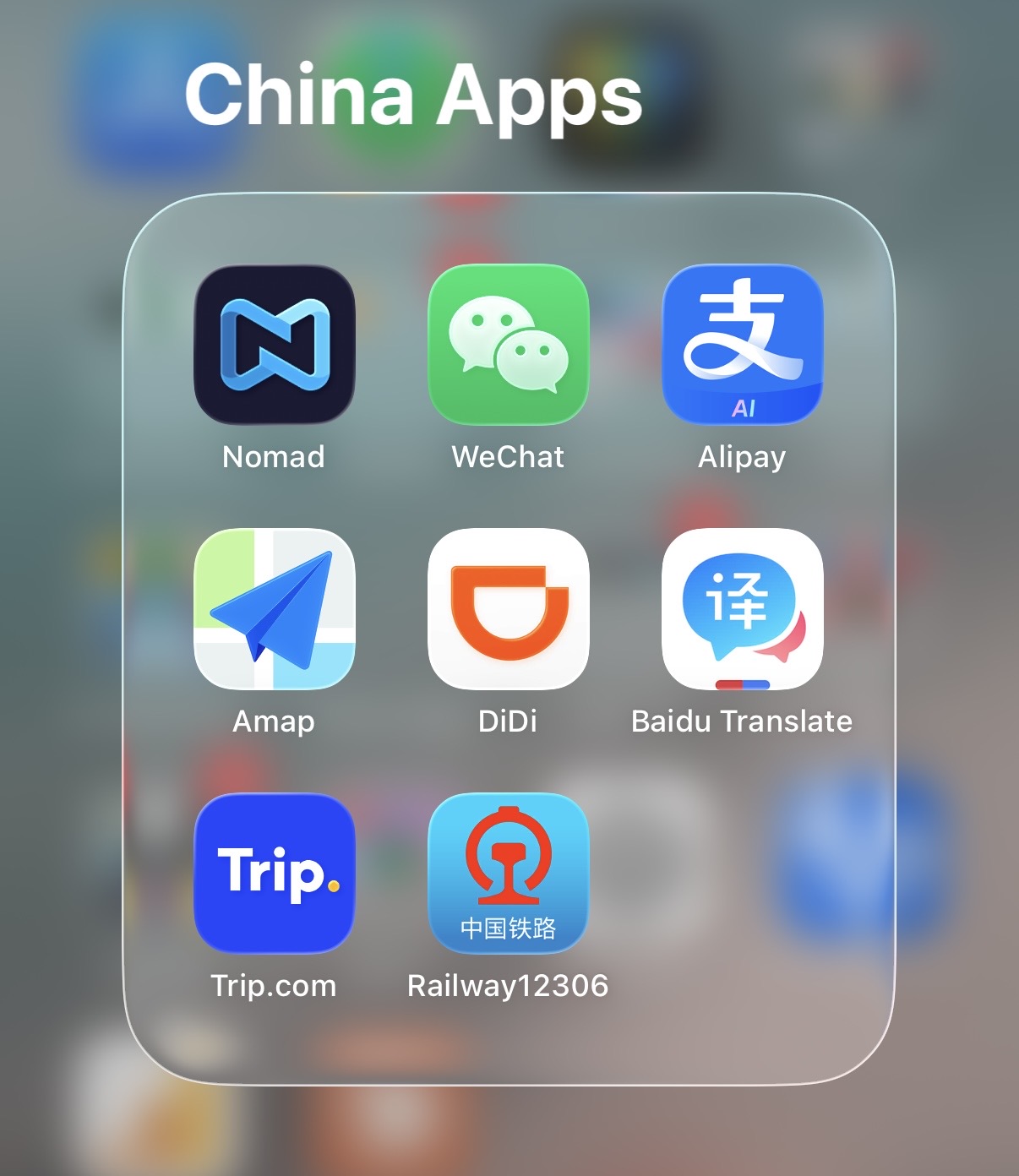
There’s a series of essential Chinese apps for everyday life, alternatives to the apps we’re already used to.
- Payments: WeChat | Alipay
By far the most complex and important app, in my opinion, is WeChat, the Chinese equivalent of WhatsApp, but also integrated with payment features and even the ability to buy train tickets or tickets for tourist attractions.
When I created my WeChat account in 2025, registration required a photo of my passport, which was then verified and approved, after which the account became active.
To be able to use the payment feature, all you need to do is add one of your own cards to the app (I added my Revolut card). Whether you use WeChat or Alipay, payments are made either by scanning the merchant’s QR code with the app, or by having the merchant scan your code from the app.
- Local Transport: DiDi
DiDi is the Chinese equivalent of Uber or Bolt. Fares are very low, rides are excellent, and payment is also done through WeChat – at the end of the ride, the transaction will appear in your WeChat payment history.
- Maps: Amap
In China, Google Maps isn’t useful, so the best and safest option is Amap. It’s an extremely well-developed app, offers all the details you need, and lets you set pins.
- Translation: Baidu | Google Translate
- Train or plane tickets: Trip.com | Railway12306
Survival Kit
Essentials for a Worry-Free Trip
Passport and Visa
Depending on nationality, some travelers must apply for a visa in advance through a Chinese embassy or consulate, while citizens of a list of countries are currently exempt and can enter visa-free.
Visa-free policies change frequently, so always check the current list before booking your trip – Chinese Ministry of Foreign Affairs’ Consular Affairs Department.
The passport is also required to visit tourist attractions, so make sure you have it with you.
Flight
There are flight options from all over the world, direct or with different layovers to China, operated by several airlines.
You can search the most convenient option for you on Kiwi.com
Internet
The best option for mobile data is using an eSIM – my recommendation is NOMAD.
Applications
- Payments: WeChat | Alipay
- Local Transport: DiDi
- Maps: Amap
- Translation: Baidu | Google Translate
- Train or plane tickets: Trip.com | Railway12306
Accommodation
As for accommodation, bookings can be made through Booking.com, Trip.com, or Agoda – my choice was Booking.com.
Transport
For getting around within cities, besides the ride-sharing option (DiDi), the subway is another great way to travel, with an extremely well-developed metro network in every city. Everything is very well organized, with signs and maps everywhere, both in Chinese and English.
When it comes to traveling between different cities, the train is an excellent choice. The trains are high-speed (running at around 300km/h), and punctuality and cleanliness are taken to another level.
Money and Payments
China’s currency is the Chinese yuan (¥ / RMB).
In most cases, payments are made through the apps mentioned earlier, but it’s always good to have some cash on hand for markets, fairs, or any other street purchases.
Airplane Mode On & Enjoy Travelling!